
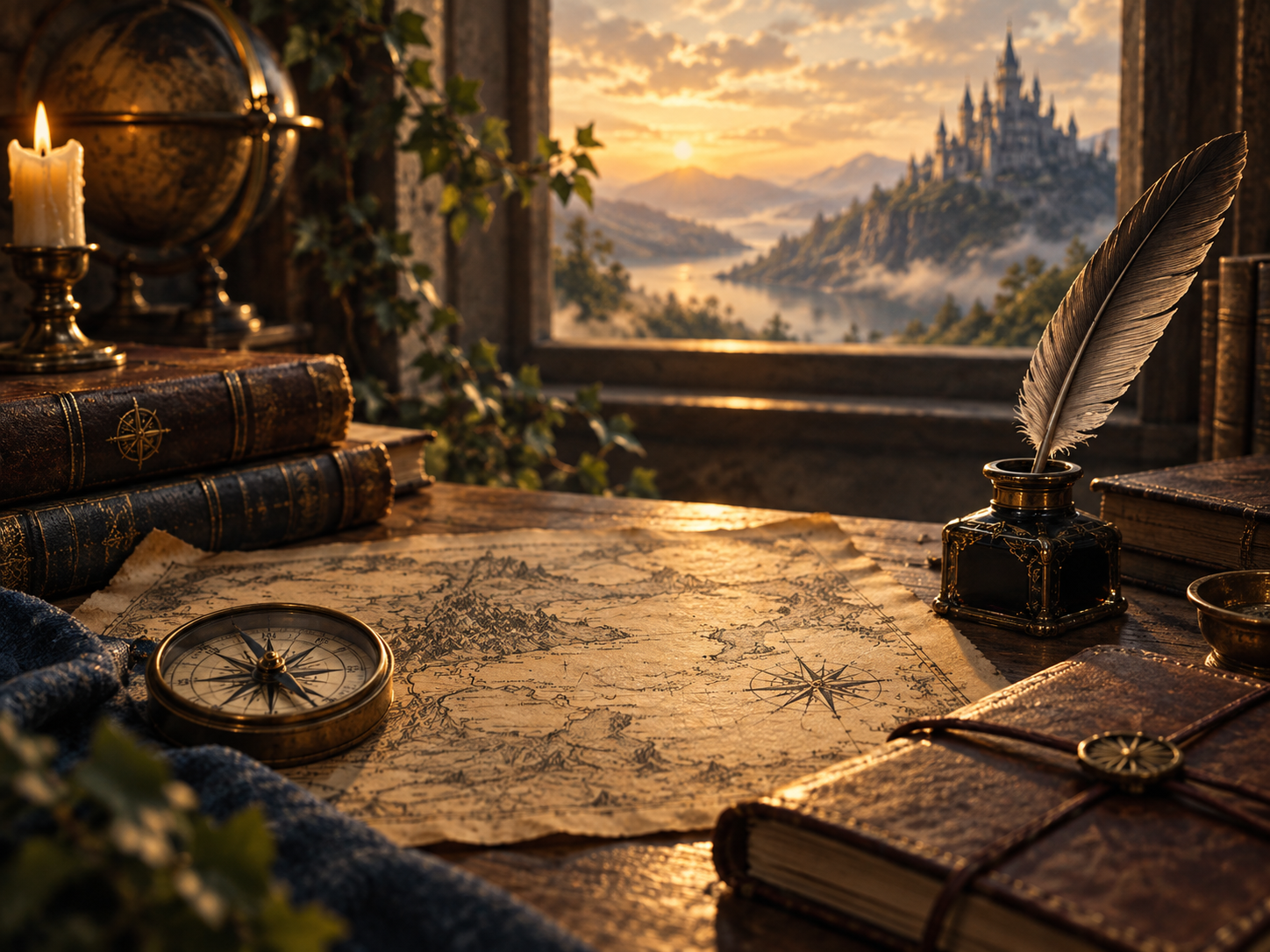
I have been telling stories for most of my life, though for a long time I probably would not have called any of it writing.
Most of those stories never made it on a page.
When I was a kid and I was told to clean my room, for example, the whole thing could gradually turn into a campaign. I was not simply putting away toys. I was a ruler reclaiming lost territories, restoring order following a civil war, or deciding which parts of the kingdom belonged to which factions. Every now and then I would stop cleaning to write something about an alliance or a dispute.
This probably explains why cleaning my room never seemed to finish.
I also read a lot of books. I mean a lot.
Books gave my imagination more material than it knew what to do with. They showed me that somebody could invent a place that had never existed and somehow make it feel real. A person who had never lived could affect you. You could close a book and continue thinking about them.
And every new world seemed to suggest another one.
That part of me never really went away.
My actual writing has been far less consistent. There have been periods when I wrote regularly, but plenty more when I hardly wrote anything at all. Some years have been more about work, family, responsibilities, or simply getting through whatever happened to be in front of me. Creative work is remarkably easy to postpone because almost everything else can make a stronger claim on the present moment.
The strange thing is that my failure to write has never erased the stories in my head.
Scenes still replay. Ideas change while I am doing something else. Characters who started one way become someone different. A world I have not thought about in years can emerge suddenly again for no obvious reason.
Some stories seem remarkably patient.
I may stop writing them, but they do not always stop bothering me.
That is one reason I keep coming back.
The other is much simpler: I enjoy it.
The Satisfaction of Creating
There is something deeply satisfying about making something that did not exist before.
It can start almost anywhere. An image. A person. A question you cannot quite shake. A conflict. Sometimes just a sentence.
Then things begin attaching themselves to it. The person wants something. The setting develops a history. A decision creates a problem you had not planned. Someone you invented to perform one small function becomes inconveniently interesting and starts changing the rest of the story.
At some point, if things are going well, writing begins to feel less like development and more like discovery.
That is one of my favorite parts of the process.
I also enjoy working with words themselves. Writing is an art form, and sentences are strange things. You can write one that is grammatically clean, communicates exactly what it is supposed to communicate, and has absolutely no life to it. Then another sentence comes along that is much simpler and somehow carries more than you intended.
I don’t pretend to completely understand why that happens. I am not sure I care to. I would rather leave some of the mystery intact.
Characters can surprise me in the same way.
A character may first exist because the plot needs somebody in a particular place doing a particular thing. Fair enough. But once that person has been around for a while, he may develop habits, fears, opinions, loyalties, and contradictions that make the original plan more difficult. You discover that something you intended for him to do no longer feels like something he would do.
That can be frustrating and also a good sign.
The character has become more than a piece of machinery for keeping the plot moving forward. You have to start listening to him.
So writing, at least for me, involves this odd paradox of control and surrender. I am obviously making this thing, but I am also finding out what kind of thing I have made.
Stories Let Ideas Become Human
I tend to circle around some fairly large subjects: faith, meaning, identity, power, morality, suffering, redemption, history, politics, human nature, and whatever else might lie beyond the part of reality we can easily explain.
That sentence alone is enough to make a person sound exhausting at dinner.
But I am interested in those questions, and they inevitably find their way into what I write.
Not because I have solved them.
Usually the opposite.
One reason I am drawn to fiction is that a story can approach ideas in a way that an argument sometimes cannot. You can define courage in an essay, but a story can give a character a very good reason to be afraid and then let that character choose courage anyway, regardless of the cost.
You can write about political corruption as a concept. Or you can follow a decent person through a series of choices, each one understandable on its own, until one day he looks around and has become the sort of person he once despised.
Suffering is similar. We can debate its meaning, causes, purpose, or apparent lack of purpose. Those discussions matter to me. But a story can do something else. It can stay with someone who wakes up the next morning when none of the explanations have made the pain go away.
Fiction puts flesh on ideas.
It gives them relationships and memories. It makes choices expensive.
And it allows readers to encounter questions before they have necessarily decided what category the question belongs in.
That matters because most of us already have categories.
Politics, economics, morality, and social questions are obvious examples. Religion most certainly is as well. Simply mentioning these subjects can reveal how quickly people reach for positions they already hold. I do too. We know roughly where we stand. Sometimes we even know what the other side is going to say about it.
A story can complicate that system.
The issue becomes a father, a daughter, a frightened politician, a faithful woman, a dishonest friend, a society trying to survive, or one person faced with two choices that both cost them something they deeply value.
Then it gets harder to stay comfortably inside those categories.
I like that fiction can do this.
What We Bring to the Page
My interests in religion, theology, history, politics, economics, and government naturally affect the kinds of stories I want to tell.
Those subjects are often treated as separate fields, but in human life they are hopelessly tangled together. What people believe affects what they value. What they value affects the institutions they build. Those institutions shape who possesses power, what gets rewarded, what gets punished, what people owe one another, what they fear, and what they are willing to sacrifice.
Even a story that never mentions an election or a church may have politics and religion operating somewhere underneath the text.
My own experiences enter the work too, sometimes more directly than I expect.
Joy enters, as does depression. Periods when life has felt full of meaning and others when meaning has been much harder to find. Things I am proud of and things I would rather not spend much time looking back on.
I suspect a lot of writing begins with some kind of dissatisfaction.
I do not necessarily mean anger. Sometimes it is curiosity. Sometimes grief. Sometimes you read something wonderful and, instead of leaving you satisfied, it makes you want to create something yourself. Sometimes there is simply a vague sense that something is missing.
A person who does not exist yet.
A place.
A question.
A story you would like to read but cannot find anywhere.
So eventually you start trying to write it yourself.
One slightly uncomfortable discovery about writing is that it also exposes the writer.
I do not mean that every character is secretly me, or that every character is simply the author in disguise.
But none of them come from nowhere.
Whatever I put into a character has to come through things I have noticed, imagined, feared, admired, wanted, regretted, misunderstood, or resisted. Even when I deliberately create someone unlike myself, I am still the one imagining what unlike myself looks like.
Every now and then that produces an unpleasant surprise.
I may begin writing a character convinced that I understand what is wrong with him. Then, several scenes later, I realize that I have given him one of my own habits. Or perhaps a fear that I recognize a little too well. Or some beautifully reasoned excuse for behavior that suddenly sounds familiar.
That is not always fun.
Other characters have brought me genuine happiness. Sometimes I like a person I have invented so much that I find myself wanting better things for them, which is a strange emotion to have toward somebody whose problems I am personally responsible for creating in the first place.
Writing can work like a mirror that way, except it does not always show you what you intended to see.
Sometimes the story tells the writer something first.
Faith and Creativity
I am a Christian, and I am unapologetic about that.
At the same time, I have no desire to waterboard people with it.
I am not interested in fiction that exists as a disguised sermon, with characters assembled mainly so the author can corner the reader and explain what everyone ought to believe. If a character exists only to repeat my opinions in a more dramatic setting, I probably have not created much of a character.
My faith does not need to be forced into my stories anyway. It already affects the way I understand the world.
It shapes what I believe about human dignity, good and evil, freedom, suffering, redemption, purpose, responsibility, and the limits of our own understanding. Even if nobody in a particular story quotes Scripture or discusses God, I am still writing from somewhere. All writers are.
Faith also affects the way I think about creativity itself.
I believe God created a reality filled with meaning and purpose. I obviously do nothing remotely comparable when I sit down and invent a fictional world, but I do think there is something significant about the resemblance.
Writers create people who inhabit worlds they did not make.
Those people act without complete knowledge. Their decisions matter to the story. They encounter consequences they cannot always predict. They may misunderstand the world around them or believe themselves to be at the center of something much larger.
As a writer, I may know something about the story that they cannot possibly know.
I find that fascinating.
It also means faith can exist in fiction beneath the obvious surface. It may appear in the dignity afforded to a broken person. In the refusal to pretend evil has no consequences. In mercy that is not deserved. In the possibility of redemption even when repair is beyond reach.
None of that requires every reader to agree with me.
I do not expect them to.
But these are questions I care about, so inevitably I will keep writing toward them.
What I Hope Writing Can Do
First, I hope the stories are entertaining.
I mean that seriously.
A story has to give someone a reason to keep reading. Whatever else I may want to explore through fiction, the reader did not pick up a novel because I had several important thoughts I wanted to share.
They picked it up for a story.
So I want to give them one.
Beyond that, I hope the writing sometimes does something more. Maybe it challenges someone. Maybe it consoles them. Maybe it bothers them for a while. Maybe a character puts words to something the reader has felt but has never managed to articulate.
I think good fiction can leave something behind.
Not necessarily an answer. I am increasingly suspicious of stories that seem to know exactly what the reader should conclude about everything.
Sometimes a better question is enough.
Would I like recognition? Of course.
Writers can become rather noble when discussing this subject, but I think most of us would enjoy having people read our work and say that it mattered to them. I would love for something I write to find a large audience. I would love for readers to care about characters who once existed only inside my head.
But that is not the thing that keeps pulling me back when nobody is watching.
I like making stories, and I always have.
Why Now?
I have spent a surprising amount of my life wanting to write while not actually writing.
That contradiction has become harder to ignore as I have gotten older.
Time does that.
The fear used to be that I might take writing seriously and fail. That fear still exists somewhere, I am sure. But another one has become more persuasive lately: the possibility of reaching the end of my life with all these stories and ideas still sitting around inside my head because I never quite found the right time to do anything with them.
That would bother me.
Responsibilities have shaped much of my adult life, as they should. There were things that deserved priority.
There still are.
But I have reached a point where I want to make room for this too.
I do not think a perfect season for writing is coming. Life is probably not going to clear my calendar, remove the distractions, settle every responsibility, and then formally announce that I may begin.
At some point, if writing matters to me, I have to give it a place before everything else is finished.
Because everything else is never finished.
This piece is part of that decision.
I have spent years thinking about stories, but I have also spent a lot of time thinking about the process behind them. Where ideas come from. Why some ideas keep growing while others collapse once you look at them closely. How characters become believable. How an imagined world begins to feel inhabited. How a collection of scenes becomes a story and, eventually, how a rough manuscript becomes something another person might actually want to pick up and read.
Most of those thoughts have stayed in my head or in private notes.
I would like to start sharing some of them.
As I work on my own novels, I plan to write here about imagination, storytelling, creativity, and the process of developing fiction from the first hint of an idea to a finished work.
I am not approaching any of this as someone who has mastered writing. I have not.
I am still learning. Still testing ideas. Still writing things that do not work and trying to understand why. I expect some of what I believe about the process now will change as I continue doing it.
That is part of the reason I am writing this now.
It gives me a place to think through what I am learning, share whatever proves useful, and hold myself accountable to the much less glamorous task of actually finishing the novels.
Maybe some of it will also help someone else with stories in their head who has spent a long time wondering what to do with them.
For now, though, this is just an introduction.
I have started and stopped writing more times than I can count.
The stories have been considerably more stubborn lately.
I think it is time I became a little more stubborn too.